
Where you spend the holidays depends on whether you want the season compressed or stretched, frozen or sun-warmed, inherited or invented. The fourteen destinations below range from Tbilisi, where Orthodox Christmas on January 7th lets you run the whole thing twice, to Medellín, where 27 million LEDs turn night into something that barely registers as dark. Each place commits to its own version completely rather than offering a generic winter copy.
Tbilisi, Georgia

The Orthodox Church still follows the Julian calendar, which puts Christmas on January 7th in Tbilisi, well after most cities have boxed up their decorations. That lag is the whole point of coming here: the lights, markets, and carols run through December as usual, but the city keeps its energy going while everywhere else feels spent.
Freedom Square turns the Liberty Monument, the statue of Saint George slaying the dragon, into a cascading light show that functions as the city’s main Christmas tree. The display reads as a little theatrical for my taste, but it draws the crowds and the square stays lively because of it.
For a place to sleep, the Stamba Hotel leans into the cozy-chic look that rental sites love: leather sofas, hanging plants, shelves of vintage books. It photographs well, and after a cold evening walking the markets, the warmth matters more than the aesthetic.
Sydney, Australia
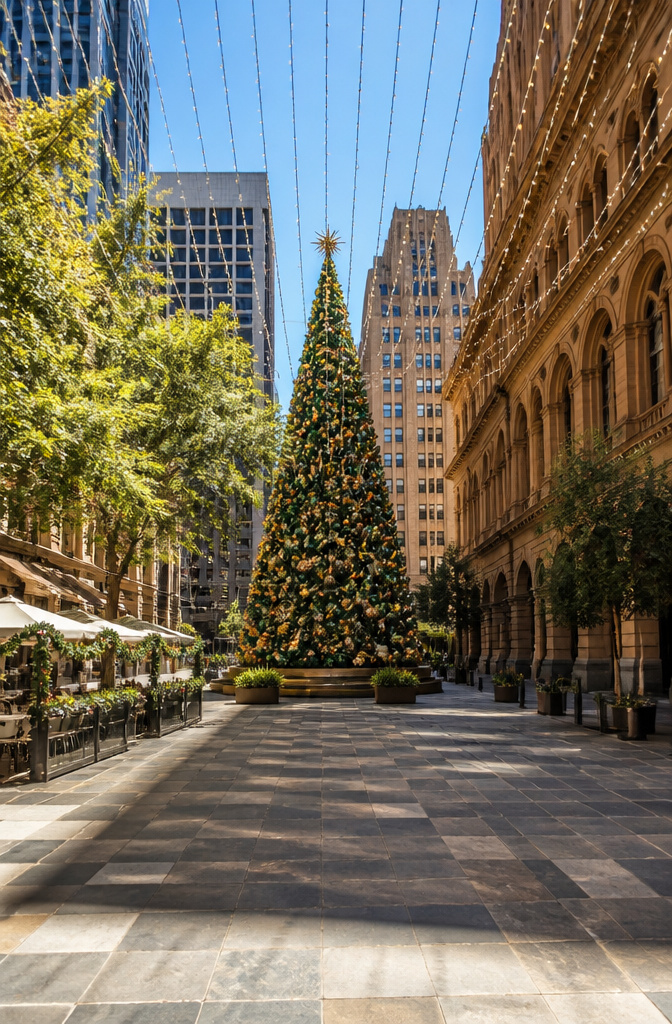
Sydney stretches Christmas across the entire month of December, and the city commits to the bit harder than most places that actually get cold. The festival centers on Martin Place and its full-size Christmas tree, which anchors a program of light displays dense enough to compete with any northern hemisphere rival. The Strand Arcade hangs 3,500 lights overhead, and Pitt Street Mall runs an LED canopy using 85,000 of them.
The warm-weather dissonance is the real story. December in Sydney is summer, so the city does not pretend otherwise. Visitors trade a fireplace Christmas for rooftop pool lounging at places like the Sofitel Sydney Darling Harbour, where the standard move is a long lunch followed by swimming. The lights still read as festive because Sydney simply runs them brighter and more extensively, as if volume can override the cognitive clash of tinsel in eighty-degree heat. It mostly works. The tree stays up, the arcade stays lit, and the holiday reads as genuine rather than ironic, but only because the scale is so relentless. Pack for actual summer and treat the Christmas theme as atmosphere rather than weather report.
Rio de Janeiro, Brazil

December in Rio swaps sweaters and cocoa for daily averages in the balmy 80s and caipirinhas on Ipanema. The dissonance is what stays with you: Santa hats against brown shoulders, Bing Crosby on speakers above the sand, the whole Northern Hemisphere playbook imported to a city that never needed it.
The city leans into the contradiction hard. The Festival de Presépios strings nativity scenes through Jardim de Alah, the strip between Ipanema and Leblon. The world’s largest floating Christmas tree anchors Rodrigo de Freitas Lagoon, visible from most angles if you rent a bike and circle the water. I would spend the hour doing that rather than fighting beach crowds for a static view.
Warm-weather holidays expose how much of the "magic" is packaging. Rio keeps the tree, the carols, the family dinners, but strips the insulation layer. What reads as cozy in Minnesota here feels slightly absurd, and that absurdity is the point. You are not escaping the holiday; you are seeing which parts survive without the cold.
San Juan, Puerto Rico

Puerto Rico stretches its holiday season across 45 days, from the end of November straight through mid-January. That length changes everything about how you experience it. Instead of a compressed rush of events, the island moves through Christmas at a pace that lets you actually participate rather than just witness.
The decorations in Old San Juan stay up long enough that you can catch them on a random Tuesday without fighting holiday-week crowds. Strings of lights hang across the painted buildings around Plaza de Armas for weeks, and the folk music keeps playing in bars and plazas as if the calendar barely matters. Midnight mass services happen repeatedly, not as one packed spectacle. You can miss a night and still catch the same energy three evenings later.
That timeline also means coquito, the coconut drink that competes with eggnog, is available long enough to become a routine rather than a one-time sample. The season earns its length through repetition; you settle into it instead of sprinting through.
From the end of November through to the middle of January, Puerto Rico boasts a holiday season that stretches across a very impressive 45 days—it’s a world record, in fact.
For a renter or first-time traveler watching both calendar and budget, that spread matters. Flights to San Juan dip outside the peak December 20–28 window, and the same lights and music wait for you.
Zagreb, Croatia

Zagreb’s Advent market sets up in Trg Bana Jelačića, the main square at the city’s heart. I kept reading that the live nativity outside Zagreb Cathedral was worth timing a trip around, and the difference from the static scenes I’d seen elsewhere became clear once I thought about what "live" actually means. Real animals, working handlers, and the slight unpredictability of both turn a display you photograph into something you watch. A donkey shifts its weight, a goat wanders toward the barrier, and the scene demands attention the way a plastic figurine never does.
The hand-carved wooden toys from Hrvatsko Zagorje are the souvenir that justifies luggage space. UNESCO added them to its Intangible Cultural Heritage list in 2009, which sounds like bureaucratic praise until you handle one and see the joint work still done by hand.
Gdańsk, Poland
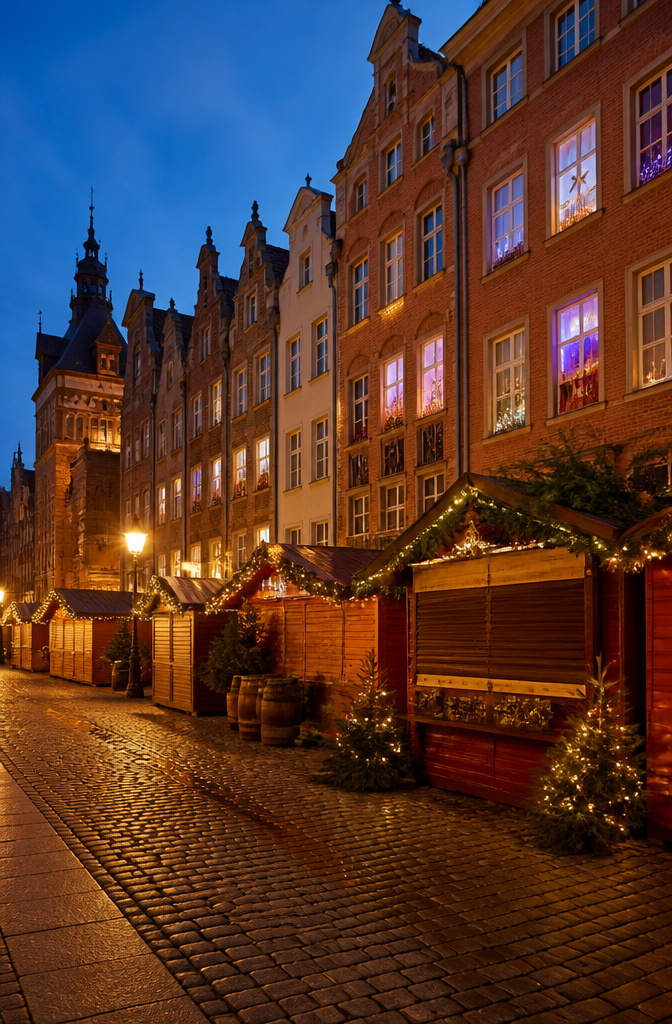
A month-long Christmas Fair lines the streets of Gdańsk’s Old Town, but the detail that stuck with me, reading about how this city paces its season, is the Advent windows: one building per day opens a decorated window for the first time, functioning as a citywide slow-reveal calendar. Each evening in December, another facade lights up its assigned window, so the whole place accumulates meaning rather than arriving fully formed. You can walk the same route twice a week and see something you missed.
The windows themselves are designed by local artists and students, which keeps the look from feeling corporate. Some are painted glass, others are lit installations you view from the cobblestones below. The fair’s month-long run means you do not need to time a visit to a single peak weekend; late arrivals still get the full count of opened windows, just not the suspense of waiting for the next one.
Reykjavik, Iceland

In Reykjavik, December darkness stretches so long that the city simply refuses to surrender to it. Glinting Christmas bulbs line the streets and parks, a human answer to the void overhead, and on the clearest evenings the northern lights drop their own curtains of green and violet across the same sky. The two light sources do not compete so much as take shifts: the bulbs hold the ground, the aurora owns the upper air, and between them the night feels occupied rather than endured.
The folklore runs on the same principle of filling darkness with character. The 13 Yule Lads, the local holiday trolls who predate the Santa Claus import, appear about town in the weeks before Christmas. Each has a name and a specific mischief, from stealing sausages to peering through windows, and the tradition turns the long nights into a sequence of small threats and small treats rather than a single grand visitation. What this means in practice is that holiday decorations here are not merely ornamental; they are part of a working system for getting through the season, the bulbs and the trolls both keeping the dark at bay until the light returns.
Cologne, Germany

Cologne’s Christmas market pulls about four million visitors each winter, a scale that reshapes the entire city for weeks. The Rhine promenade and the squares around the Cathedral clog with foot traffic from morning until the stalls close, and the smell of mulled wine hangs in the cold air blocks from any actual vendor. Hotels within a ten-minute walk of the Cathedral, like the Cologne Marriott, price for the demand and still fill up; walking distance becomes the only distance that matters when U-bahn platforms pack tight enough to miss two trains.
The view from the KölnTriangle observation deck, directly across from the Cathedral, is what makes the crush worth planning around. From up there the market spreads below as a grid of light and wood smoke, and you understand why Germans treat this tradition with such seriousness. I would not bother trying to dodge the crowds; they are the point. Go early in the week if you need breathing room, or accept that Saturday evening in December means shoulder-to-shoulder passage through the Altstadt.
Copenhagen, Denmark

Tivoli Gardens runs its antique rides year-round, but the same wooden coaster and spinning carousels hit different in December. The park strings lights across the ironwork and frames the whole thing as an Alpine village-style Christmas market, so a ride that felt like nostalgia in July becomes something closer to time travel when the sun drops at four in the afternoon. The tree here gets dressed with Swarovski crystals, which sounds excessive until you see it against the dark. The trick is timing: go after dusk, when the market stalls are lit and the rides have stopped looking like an amusement park and started looking like a set piece. The whole place is engineered for hygge, that Danish obsession with coziness that the country practically exports. If you want the full ritual, book a table at Restaurant Vita for andesteg, the roast duck with prunes and apples that shows up on holiday tables here. Denmark ranks high on the World Happiness Report, and Tivoli in December is where that statistic starts to feel like an actual place you can walk into.
Kennebunkport, Maine

The Christmas Prelude in Kennebunkport runs eleven days, and the lobster trap tree is what stops people on the sidewalk. Traps stack into a pyramid where another town would string lights on spruce branches, and the message is hard to miss: the working harbor here does not take December off. Santa arrives the same way, on a lobster boat rather than a sleigh, which reads as gimmick in the brochure and something else entirely when you are standing on a working dock smelling diesel and bait. The traps are local gear, not props, pulled from boats that will go back out in January. That distinction matters if you are deciding between this and a town that imports its holiday aesthetic. The Clam Shack keeps its lobster rolls running through the event, and the White Barn Inn lays on Santa at afternoon tea if you want the full package. For a renter or first-time owner used to decorating with what is already in the room, the trap tree lands differently than a store-bought angel.
Edinburgh, Scotland

The sprawling holiday market at East Princes St. Gardens sets up in a long green band that drops below street level, with the Scott Monument rising behind one end and the bulk of the Old Town across the way. Stalls line paths that follow the garden’s natural slope, so you’re walking downhill into the market and uphill back out, with the castle on its rock visible above the rooftops the whole time.
The market runs through late December and feeds straight into Hogmanay, the three-day New Year festival with concerts and fireworks that takes over the same streets. If you want to stay in it, The Balmoral sits above the gardens on Princes Street itself, with rooms that look across to the castle and down into the market below. The building is hard to miss: domed, sandstone, built to face the gardens before they had a Ferris wheel in them.
Whisky is the obvious warmth here, though the market does mulled wine and the usual holiday food well enough. Edinburgh Castle itself hosts Christmas lunches, which sounds like a tourist trap and probably is, but the view from inside those walls is real.
Bruges, Belgium

Cobblestone streets laid in the 1300s do not care about your rolling suitcase, and that is part of the point. Bruges keeps its medieval street plan intact, which means the holiday market sets up where carts once turned, and the Winter Glow trail threads through ten light installations that have to work around corners and canals never designed for crowds. The effect is cramped and genuinely magical in a way that open plazas rarely manage. Belgian hot chocolate tastes better when you are wedged into a café that has served the same narrow plot since before the concept of central heating. Grand Hotel Casselbergh sits steps from the Markt with exposed wooden beams and a wellness center dropped into a 16th-century cellar, which tells you how this city handles modern comfort: squeezed into what already exists, never replacing it.
Medellín, Colombia

Medellín earns its "City of Eternal Spring" nickname year-round, but the December holidays are when that mild weather pays off in a very specific way. The Alumbrados festival, running since 1967, drapes the city in roughly 27 million LED lights. That density turns the nighttime into something that barely registers as night at all; the river corridors and main avenues glow at a level where shadows struggle to form and the sky itself takes on a faint wash of color. It is not decorative lighting in the American sense, where a downtown tree gets a few strings. It is structural, wrapping bridges and climbing hillsides until the geography itself seems to have switched on.
The effect is disorienting at first, then practical. You do not need a plan for the evening to work; walking anywhere in the Poblado or Laureles districts after dark becomes the plan. Morning is for recovery, and the city knows it. Coffee shops open early with the heavy, sweet pastries Colombians favor, and the light show does not start again until dusk, so the rhythm of the day writes itself.
London, UK

Georgian townhouses line streets like Bedford Square and Mayfair with their symmetrical brick facades and fanlights above painted doors, and the ones dressed for December are the ones worth walking past after dark. The public side of the holiday happens in the pubs, where strings of lights and garlands turn low ceilings into something you want to lean into with a pint. That warmth is deliberate; the Victorians built on Georgian bones and the layering stuck. Somerset House off the Strand opens its 18th-century courtyard for ice skating, which is where the crowds go for the spectacle. The private celebration stays behind those townhouse doors, where high ceilings and tall windows were built for candlelight and a single tree visible from the street. I would skip Claridge’s and the martini markup; the same atmosphere costs nothing from the pavement if you time the walk for dusk and end at a pub with a fire going.
Holiday Traditions That Define Each Place
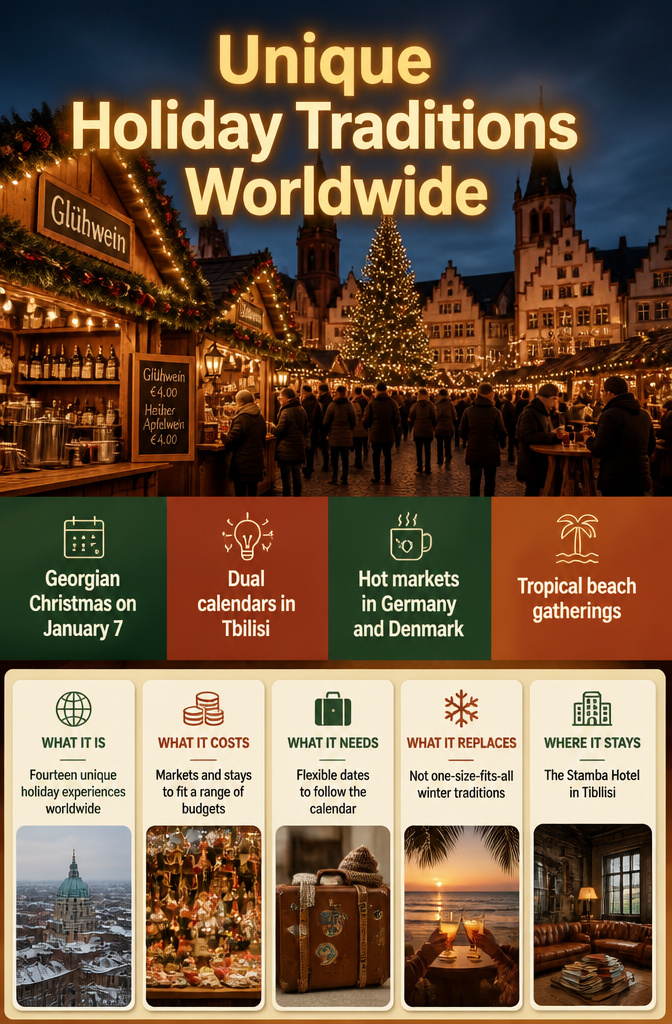
European Christmas markets still set the standard most travelers picture first: wooden stalls, mulled wine, lights on medieval squares. But the calendar itself shifts depending on where you stand. Georgian Christmas falls on January 7, two weeks after the Western date, because the Orthodox Church follows the Julian calendar. Tbilisi stretches the season by starting its light displays and caroling in December anyway, so the city gives you both calendars at once.
That same stretch happens in reverse for Orthodox observances elsewhere. Someone chasing an extended holiday could string together late-December markets in Germany or Denmark with a January arrival in the Caucasus, getting two full cycles without doubling back.
Tropical destinations trade the whole format for beach gatherings and open-air evening parties, warm enough that the heavy coat and the hot spiced wine never enter the equation. The contrast is deliberate: the fourteen locations range from Copenhagen’s snow-dusted rooftops to white-sand beaches where the 25th is toasted in sandals. What unifies them is that each place commits to its own version completely rather than offering a generic winter copy.
The Stamba Hotel in Tbilisi sums up the appeal in one building; its leather sofas and stacked vintage books lean into the cozy aesthetic that travelers already associate with the season, just planted where the cold is lighter and the dates run longer.
Where to Stay

The right room can turn a trip into a holiday you actually remember. I look for places that let the location do the work: a cottage with a wood stove in a village that shuts down by six, or a flat above a bakery where the morning smell becomes your alarm clock. In cities, I used to default to hotels near the tourist center and always ended up cabbing back late, tired, and eating overpriced room service. Now I stay a metro stop or two outside, in a neighborhood flat where I can pick up bread and cheese on the way home and feel like I live there for a week.
The type matters less than the fit. A cabin with thin walls ruins a snowy mountain trip when you hear every neighbor’s television. A sleek apartment in a historic district can feel sterile if the owner cleared out every trace of local life. I check photos for the practical stuff: where you will put wet boots, whether the kitchen has more than a kettle, if the windows open onto a street or a wall. Those details cost nothing extra and make the difference between resting and just sleeping somewhere else.
What to Do When You Get There
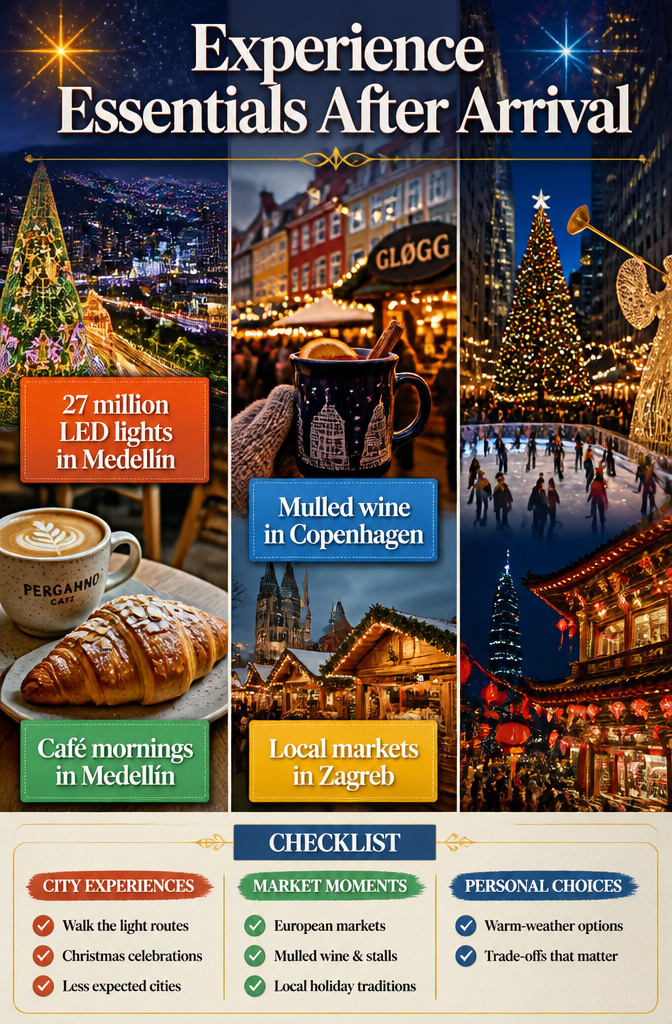
The holiday spirit in Medellín starts with 27 million LED lights strung across the city for the Alumbrados, a display that began in 1967 and runs through the season. I would plan at least one evening just to walk the routes slowly, since the scale only makes sense on foot.
- In Medellín, pair the lights with a morning routine: coffee and an almond croissant at Pergamino Café before the crowds gather.
- European markets in Copenhagen and Cologne reward the cold-weather traveler with mulled wine and stalls packed tight enough to warm you by proximity alone.
- Chicago and New York hold their own against those European classics, with celebrations that match the density if not the centuries of tradition.
- Warm-weather options exist for anyone who would rather toast on white sand than under snow, though the passages do not name specific beaches or resorts.
- Zagreb and Taipei round out the list for travelers who want something less expected, each with its own local take on the season.
The choice comes down to what you are willing to trade: the spectacle of engineered light against the intimacy of a market stall, or familiarity against the slight friction of a place where Christmas does not come with your childhood soundtrack.
Frequently Asked Questions
where do you spend the holidays?
The best destinations range from classic European Christmas markets in Copenhagen, Cologne, and Zagreb to warm-weather escapes like Sydney, Rio de Janeiro, and Medellín. Tbilisi and Puerto Rico extend the season well beyond the typical dates, while Reykjavik and Edinburgh offer dramatic winter settings with lights against long nights. Each place commits fully to its own version of the holiday rather than offering a generic copy.
What are some unique holiday traditions around the world?
Tbilisi celebrates Christmas twice, once in December and again on January 7 under the Orthodox calendar. Gdańsk opens one decorated Advent window per building each evening through December, creating a citywide slow-reveal calendar. Reykjavik’s 13 Yule Lads, local trolls with specific mischiefs, appear throughout the season rather than a single Santa visit. Puerto Rico stretches its holiday across 45 days, from late November through mid-January, with folk music and coquito available long enough to become routine.