
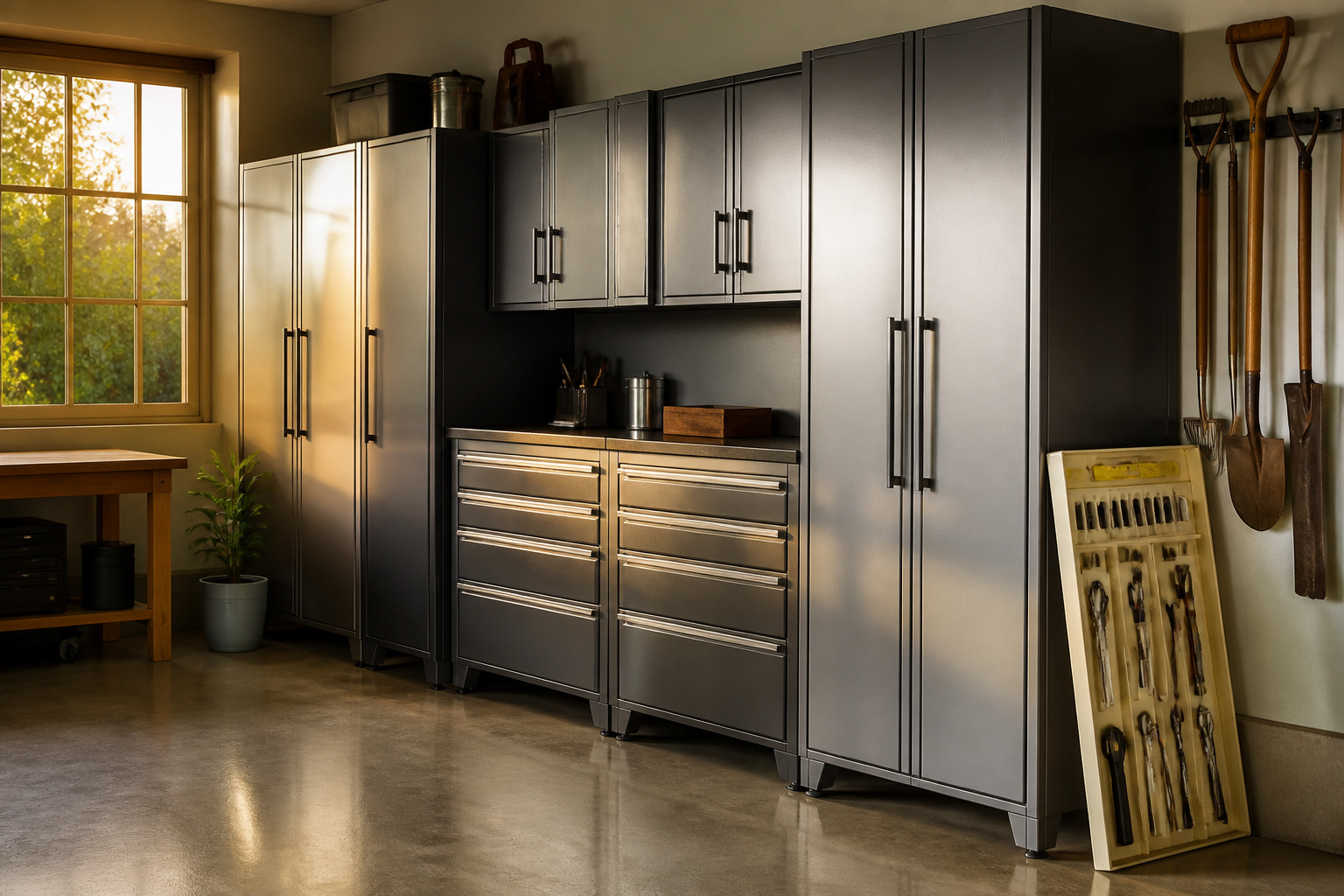
Metal garage cabinets are steel storage units built for the weight, moisture, and abuse that destroy anything meant for indoor closets. The catch is that not all steel is equal: an 18-gauge frame shrugs off dents that would crease a 24-gauge door, and a wall-mounted Craftsman cabinet tops out at 200 pounds while a welded NewAge locker holds 900.
Wall-Mounted Cabinets

Wall-mounted metal garage cabinets hang off the wall studs and leave the floor clear for parking, workbenches, or the inevitable pile of things you haven’t sorted yet. The Gladiator Full-Door Wall GearBox is the one that tends to come up first in conversations about this category: steel construction, a full-height door, and shelves that adjust without wrestling the whole unit off the bracket. The diamond-plated finish looks sharper than it has any right to in a garage, though the metal doors do sound tinny when you shut them, something to expect if you’re working late and the household is sleeping.
Stud-mounting is non-negotiable. Drywall anchors will eventually pull, and a cabinet full of power tools does not forgive that mistake. A stud finder, a level, and lag bolts rated for the load are the actual installation. Weight capacity varies by mounting method more than by the cabinet itself, but the Craftsman Wall Cabinet line is rated to hold up to 200 pounds when properly anchored. Fall short on the fasteners or miss a stud, and that number drops to whatever the crash test decides.
Floor Cabinets

Floor cabinets are the entry point most homeowners land on when they start shopping for metal garage cabinets, and for solid reasons. They sit right on the concrete, no wall studs or ceiling height to worry about, and the price stays low enough that a single weekend project does not have to wait for next year’s tax return. The tradeoff is exactly what the setup suggests: bending and lifting every time you need a tool or a can of sealant gets old fast, so these work best for items you pull out a few times a year rather than every Saturday morning. Assembly is part of the package. The panels and hardware ship flat, and putting them together takes an evening with a screwdriver and a rubber mallet. A second pair of hands helps when the cabinet grows tall enough to wobble before the back panel locks it square, though plenty of people manage solo if they work against a wall.
Rolling Cabinets

Rolling cabinets move the work to you instead of you to the work. The Manhattan Comfort Fortress Rolling Cabinet ships with a wall-mounting kit, but the casters are what make it worth considering: four wheels let you roll heavy tools or seasonal gear exactly where you’re unloading the car or working on a project, then lock them when you need the cabinet to stay put.
Caster locks can be annoyingly wobbly, so this is not the setup for precision work or for stacking the heaviest loads to the top. The tradeoff is real: you gain portability and lose some of the rock-solid feel of a floor cabinet that never moves. Side panels on the Fortress feel a bit flimsy, though the rest of the cabinet holds solid once assembled. Assembly itself is straightforward despite the abundance of nuts and bolts, but you’ll need at least a Philips-head screwdriver and some patience.
For items you want easily moved around, the extra cost over a fixed floor cabinet tends to pay out in convenience. For anything you want truly immobile, skip the wheels and bolt it to the wall instead.
Freestanding Cabinets

Freestanding cabinets give you the most storage per square foot of anything that sits in a garage without touching a wall. The Kobalt Freestanding Steel Garage Cabinet is the one that keeps coming up in comparisons, and for good reason: these units routinely hold more than 600 pounds across their shelves, with some locker-style configurations rated to 800 or even 900 pounds depending on depth and frame construction.
That weight capacity is what separates them from lighter options. A 24-gauge steel frame with fully welded corners handles loaded tool cases, bulk supplies, or a small engine without the sway you get from thinner assemblies. The tradeoff is the footprint and the delivery. These cabinets ship in crates, not boxes, and once assembled they do not slide easily across concrete. You commit to where they land.
Depth matters more than people expect. Standard models run 18 inches deep; extra-deep cabinets push to 24 inches and add roughly 30 percent more usable volume for the same wall length. The decision between them is simple: if you store bins and boxes, the deeper cabinet prevents the half-row of wasted space behind your front layer. If you mostly hang tools on pegboard inside the doors, 18 inches keeps everything within arm’s reach without stepping backward into your car.
Premium Steel Gauges

Steel gauge numbers run opposite to common sense: the lower the number, the thicker the metal. An 18-gauge cabinet uses heavier steel than a 24-gauge frame, and that difference shows up the first time you lean into a door or load a shelf near its limit.
The thicker steel in premium lines matters for the same reason car doors feel different from filing cabinets. Dents form harder, weld points hold longer, and the whole box keeps its square through years of seasonal humidity swings in an unconditioned garage. NewAge’s Diamond Plate series builds its frames from 24-gauge steel and still hits an 800-pound locker capacity; their Bold XL series moves to fully welded construction and pushes that to 900 pounds. Both carry limited lifetime warranties, which is where the brand puts its money behind the claim that the steel will outlast the hardware.
For a garage that sees real tool weight or the occasional bump from a trailer hitch, the upgrade in gauge is less about looks and more about whether the cabinet still closes straight five years in. The warranty is nice, but the thicker steel is what keeps you from ever testing it.
Assembly and Installation
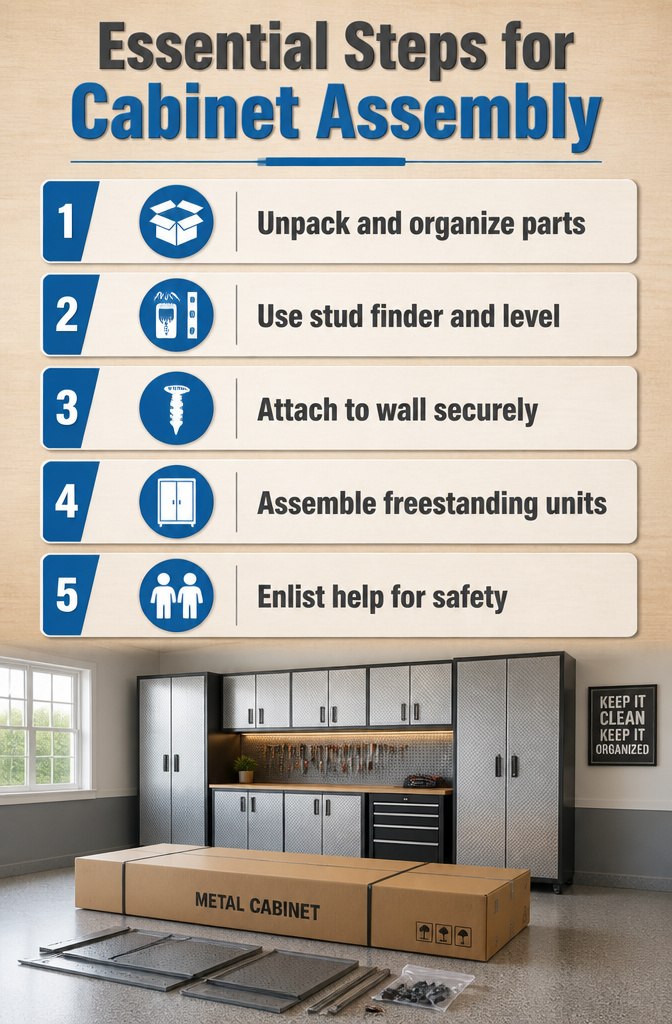
- Most metal garage cabinets arrive flat-packed, and the larger the box, the longer the afternoon. Wall-mounted units demand a stud finder, a level, and fasteners rated for the load; drywall anchors alone will not hold.
- Wall cabinets top out around 200 pounds when properly anchored into studs. Anything heavier risks the mount, not the steel. Mark stud locations before lifting anything overhead, and check level in both directions before the final tighten.
- Some freestanding cabinets ship pre-assembled or with tool-free connection systems that snap together in minutes rather than hours. These skip the hardware bag entirely, though they still need a second person to stand upright without pinching fingers or scratching paint.
Weight Capacity by Cabinet Type

A wall-mounted Craftsman cabinet lists its steel construction at 200 pounds, which covers a couple of power tools and a bin of hardware before you hit the limit. Floor and freestanding units scale up fast. The Rubbermaid resin double-door cabinet carries 690 pounds, and welded-steel locker-style frames from NewAge jump to 800 or 900 pounds depending on depth and gauge.
That 900-pound figure sits at the top of what most homeowners will find in stock configurations. For context, a loaded rolling tool chest with grinder, drill press, and a few dozen socket cases can push past 600 pounds on its own, so the gap between "hang it on studs" and "set it on the floor" matters for anyone who keeps more than the basics.
| Cabinet type | Typical weight capacity | Frame or material |
|---|---|---|
| Wall-mounted | Up to 200 lbs | Steel |
| Resin floor | 690 lbs | Durable plastic |
| Diamond plate locker | Up to 800 lbs | 24-gauge steel |
| Extra-deep welded locker | Up to 900 lbs | Fully-welded steel |
The 700-pound jump from wall to locker is the decision point. If you are storing yard tools, automotive jacks, or a full set of pneumatic gear, anything under 600 pounds leaves you managing weight like a luggage scale at the airport.
What the Warranty Actually Covers

A limited lifetime warranty on metal garage cabinets sounds like a promise that the unit will outlast the tools inside it, but the paperwork tells a quieter story. What NewAge Products actually covers spans the Bold XL and Performance Diamond Plate lines alike: welded frames, doors, and hardware against defects in material or workmanship for the original purchaser. The Bold XL carries that warranty on fully-welded steel frames rated to 900 pounds per locker, while the Diamond Plate series applies it to 24-gauge steel frames rated to 800 pounds.
In practice, this means the manufacturer will replace a failed weld or a warped door panel, not a scratched surface from sliding a mower in too fast. The warranty does not cover rust if the cabinet lives in an unsealed garage near a coast, and it does not transfer if you sell the house. For buyers comparing brands, the presence of a limited lifetime warranty signals confidence in the frame construction, but the weight rating matters more for actual durability. An 800-pound locker that holds half that load for fifteen years is a better value than a 900-pound unit whose doors sag in year three because the shelves were overloaded daily.
Frequently Asked Questions
What are the best metal garage cabinets?
The best pick depends on how you plan to use it. Wall-mounted units like the Gladiator Full-Door Wall GearBox keep the floor clear, the Manhattan Comfort Fortress Rolling Cabinet adds mobility with lockable casters, and the Kobalt Freestanding Steel Garage Cabinet handles the heaviest loads at 600 to 900 pounds. Match the cabinet type to your available space and whether you need portability or maximum capacity.
How much weight can garage cabinets hold?
Wall-mounted cabinets top out around 200 pounds when anchored into studs. Floor and freestanding units scale up sharply: resin models like the Rubbermaid double-door cabinet hold 690 pounds, while welded-steel locker frames from NewAge reach 800 or 900 pounds depending on depth and gauge. That 700-pound gap between wall and locker cabinets is the decision point for anyone storing heavy tools or automotive gear.
How do I install wall-mounted garage cabinets?
You need a stud finder, a level, and lag bolts rated for the load. Mark stud locations first, check level in both directions, and tighten only after confirming both. Drywall anchors alone will pull out over time, and a cabinet full of power tools makes that mistake expensive. A second person helps when lifting the unit overhead.