
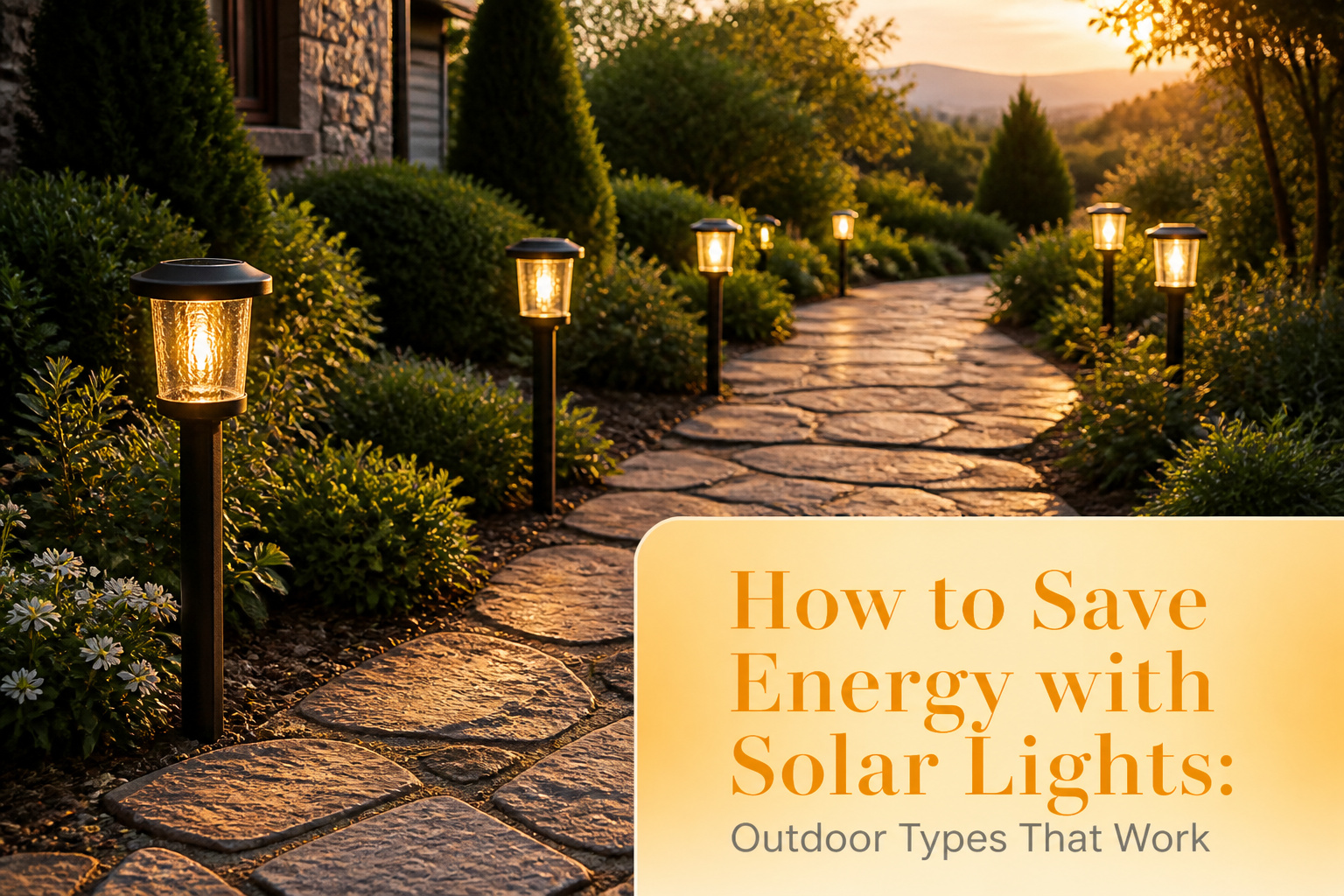
Solar outdoor lights run on small panels and rechargeable batteries, so they draw zero electricity from your household wiring once installed. The catch is placement: a panel tucked under a tree canopy or eave will dim out by ten o’clock, while six hours of direct sun keeps most units glowing until midnight. A single traditional 60-watt fixture left on eight hours nightly adds about $50 a year to your bill; solar eliminates that line item entirely, break-even included.
1. Pathway Lights

Solar pathway lights stake into the ground along driveways and walkways, marking edges you would otherwise trip over in the dark. The safety piece is immediate; the aesthetic part grows on you once you stop stubbing your toe on the same paver every evening.
A set runs about $80, which covers most standard driveway lengths or a winding front walk. Each unit charges through the day and switches on automatically at dusk, typically running six to twelve hours on a full battery depending on how much sun the panel saw. That range matters in practice: a shaded maple canopy can knock you toward the low end, while open-sky exposure keeps them glowing until midnight.
Because they run independent of the grid, they draw zero electricity from your meter. The panels and batteries do the work, so there is no wiring to trench, no outlet to protect from weather, and no line item on the power bill for that light you left on. During an outage they keep working, which is worth more than it sounds when you are carrying groceries up an unlit path.
2. Spotlights

Solar spotlights give you focused light exactly where you want it, not a flood across the whole yard. That precision is what makes them an actual energy saver: a narrow beam on one tree or the corner of your porch draws the eye without wasting power on the grass you do not need to see.
I have learned to aim them slightly downward and off to the side of the feature, not straight on. The grazing angle catches texture better, and the fixture itself stays out of the sightline. Most units now run on small panels built into the head or on a short cord, so you can tuck the panel in sun while the light sits in shade.
The real limit is runtime. A spotlight pulling from a battery all night will dim by morning unless the panel got solid daytime charge. I treat them as accent tools, not security lighting, and accept that winter days mean shorter hours. For renters, the stake-mount ones move with you; the wall-mounted brackets leave only small holes to patch.
3. String Lights

Solar string lights earn their place in a weekend project because they run on stored sun and add nothing to the monthly bill. The trade-off is placement: the tiny panel needs direct light for a solid charge, or the strand dies out by nine o’clock on a Tuesday when you actually want it.
A 27-foot rubberized cord with shatterproof LED bulbs, rated to 122°F, gives you the warm white glow without the glass cleanup. The viral 42-foot Artika Blaze set, when you can find it, adds a USB-C backup for winter weeks when daylight runs short, which is the honest admission that solar alone sometimes isn’t enough.
Mount the panel due south, tilted toward noon sun, and keep it clear of overhangs. A strand draped under a tree canopy looks romantic at noon and stays dark at eight. The extension cord on some sets lets you separate the panel from the bulbs, so the lights hang where you want them while the collector sits in the open. Four lighting modes sound like a bonus, but in practice you will pick one and leave it.
4. Wall Lights

Solar wall lights mount right to siding, brick, or stucco with two screws and no wiring at all, which makes them the safest bet for renters who cannot touch the electrical box. The whole fixture lives on the outside of the wall; the panel charges through the day, and at dusk the LED comes on without drawing a watt from the grid. I looked at dozens of setups for my own porch, and the ones that lasted were the ones with the solar panel built into the face of the light rather than on a separate cord you have to route somewhere sunny. No electrician means no landlord notice, and when the lease ends you patch two screw holes and take the light with you. That portability is the real advantage over hardwired sconces, which sources agree are costly to install and impossible to relocate. For a weekend project under $100, wall lights cover entryways, back doors, or garage-side dark spots that otherwise stay black until someone runs conduit.
5. Motion Sensor Lights

Motion sensor lights solve the problem that keeps outdoor lighting from actually saving energy: most fixtures burn all night whether anyone is there or not. A solar unit with passive infrared detection stays dark until something moves, then flips on its full output only for the minutes you need it. That is the difference between zero draw from the grid and a fixture that still costs you through dawn.
The Aootek four-pack runs about $18 and gives you three modes to choose from: straight motion activation, always-on, or a smart brightness setting that dims rather than shuts off. Detection reaches 36 feet across a 120-degree sweep, which is enough coverage for a driveway or back door without stacking multiple units. IP65 waterproofing matters less for the energy math than for longevity, but a light that dies in two seasons because water got in is not saving anyone money.
For renters especially, the appeal is that you are not wiring into a landlord’s circuit. Stick it up, let the panel charge through the day, and the battery handles the rest. The real efficiency gain is behavioral: the light trains you to stop leaving a porch lamp on "just in case," because the sensor has already handled the case.
6. Decorative Lights

Decorative solar lights come in enough styles that you can treat them as outdoor jewelry rather than infrastructure. Copper-wire fairy lights wrapped through a balcony railing, Moroccan-style lanterns hung from a pergola, or stake lights shaped like flowers along a garden edge all run on the same small panel and battery setup. The visual interest is immediate, and the electricity cost stays at zero after you set them down.
Installation rarely needs more than a stake into soil or a hook into siding. No trenching, no extension cords snaking across the lawn, no calling an electrician to add a junction box. For renters especially, that matters. You can pull them up and take them to the next place, or move them around on a Saturday when the patio layout starts feeling stale.
The upfront price runs higher than a string of plug-in LEDs from a big-box store, but the gap closes once you factor in the avoided wiring and the years of no utility draw. On my own projects, I have watched cheap plug-in strands yellow and fail in two seasons while the solar set I spent more on initially is still running four years later. The lesson cost me about thirty dollars in replacement strands before I switched.
How Solar Lights Cut Energy Use
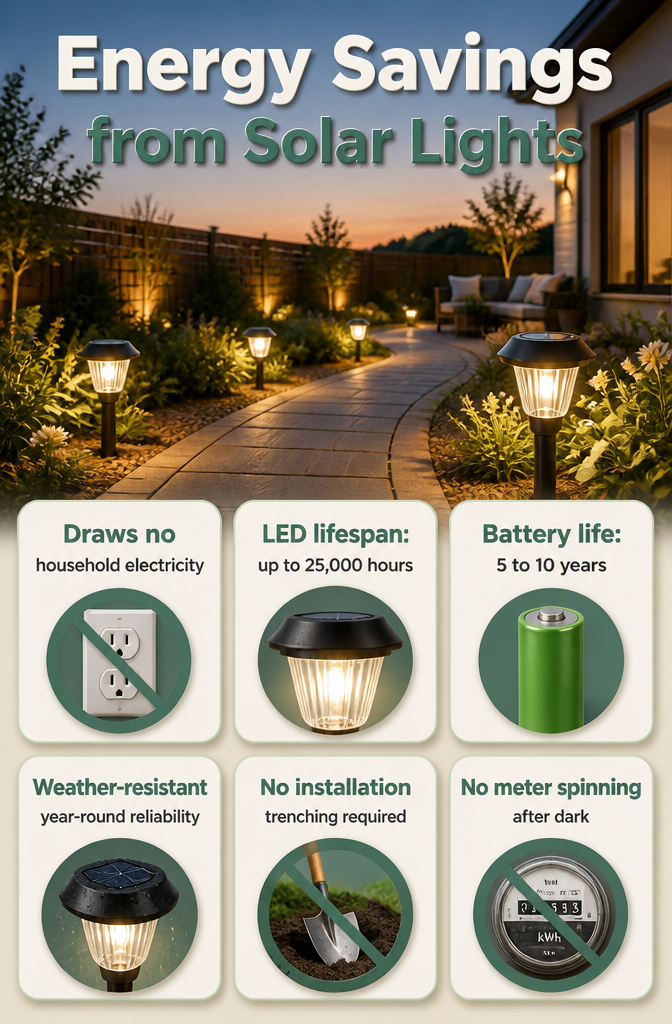
A small solar panel on each fixture collects photons during daylight hours and converts them into direct current electricity, which rechargeable batteries store until dusk. The light then runs entirely on that stored charge, drawing nothing from your household wiring. LED bulbs in these fixtures last up to 25,000 hours, and the batteries themselves typically hold up for 5 to 10 years before replacement. That lifespan matters for anyone who has swapped out a burned incandescent every season; the panel and battery assembly keeps working through weather that would trip a breaker on a line-powered setup. No trenching for cable, no outlet placement limiting where you can put the light, and no meter spinning after dark.
What the Savings Actually Look Like

A single traditional outdoor fixture running 60 watts for eight hours a night adds about $50 a year to an electric bill. Multiply that across a yard’s worth of path lights, wall sconces, and spotlights, and the annual cost runs into the hundreds. Solar lights eliminate that ongoing draw entirely. The upfront price runs higher than wired fixtures, but the break-even math is straightforward: every month without a lighting line item on your utility bill pulls you closer to offsetting the initial cost. Over a few years, the gap closes, and after that the savings are pure gain. The panels and batteries keep getting more efficient, so the return only improves if you replace or expand later.
Installation Without an Electrician

Solar lights carry their wiring at the top of the pole, so no underground conduit or trenching is required. That single difference is what makes them workable for renters and for spots where the nearest outlet is fifty feet away. I set a pair of path lights last spring in a bed where I had no outdoor plug, and the whole job was pound the stake, angle the panel, and step back.
Placement matters more than hardware. Six hours of direct sun keeps most units running through the night, so the panel, not the bulb, should face the open sky. I have made the mistake of tucking one under a eave for looks and watching it dim out by ten. Now I set the panel first, let it charge a day, then decide where the actual light points. If the garden shifts, the stake comes back up in five minutes; no conduit to abandon, no holes to patch for a landlord.
Carbon Footprint and Sustainability

Every solar light in the yard runs on energy the panel collected that afternoon, which means zero draw from the grid after sundown. For renters and first-home owners who are already conscious of what their monthly bills cost in carbon, that is a concrete shift: the porch light, the path markers, the string lights over the patio, all of it powered without touching fossil fuel generation.
The sources describe this as a reduction in carbon-intensive reliance, but the lived version is simpler. You are not waiting for a utility to green its mix; you made the swap yourself in an afternoon, usually for under a hundred dollars total. That directness matters when you do not own the roof to panel, or the landlord holds the lease on major upgrades. Solar lights let you claim the environmental benefit without waiting for permission.
Communities notice, too. A front yard running on its own small panels makes the choice visible. Neighbors stop to ask whether the fixtures were hard to set up, and whether the light lasts the full evening. Each conversation is a small push toward wider adoption, which is how individual projects scale beyond your property line.
Keeping Panels Working

Dirt on the panel is the silent killer of solar light performance. A thin layer of dust or pollen can cut charging efficiency enough that the fixture dims out hours before it should, and the fix takes about thirty seconds with a damp cloth. I clean mine whenever the garden hose is already out, which ends up being every few weeks in summer and almost never in winter.
The only real long-term task is battery replacement every 5–10 years, depending on the technology inside the fixture. LEDs themselves run for two decades or more, so the battery is the part that eventually quits. Most units use standard rechargeable sizes you can swap yourself with a screwdriver; check the housing label before you buy so you know whether the battery is accessible or sealed in.
Placement matters as much as maintenance. A panel parked under a tree canopy or eave will charge poorly no matter how clean it is, so the best upkeep is really the ten minutes you spend moving the stake to full sun.
Frequently Asked Questions
How do solar lights work?
A small solar panel on each fixture collects sunlight during the day and converts it into electricity, which rechargeable batteries store until dusk. The light then runs entirely on that stored charge, drawing nothing from your household wiring. LED bulbs in these fixtures last up to 25,000 hours, and the batteries themselves typically hold up for 5 to 10 years before replacement.
What are the benefits of solar lights?
Solar lights eliminate electricity costs for outdoor lighting entirely, since they run on stored solar charge rather than grid power. They require no wiring, trenching, or electrician, making them ideal for renters and remote spots. They also keep working during power outages and reduce your carbon footprint by drawing zero fossil fuel-generated electricity after sundown.
How long do solar lights last?
LED bulbs in solar fixtures last up to 25,000 hours, and the batteries typically hold up for 5 to 10 years before needing replacement. The panels themselves keep working through weather that would trip a breaker on line-powered setups. The only long-term maintenance task is swapping the battery, which most owners can do themselves with a screwdriver.
Can solar lights work in cloudy conditions?
Solar lights can still charge on cloudy days, though performance may be reduced and runtime will likely be shorter. A shaded maple canopy can knock runtime toward the low end of six hours, while open-sky exposure keeps them glowing until midnight. Some string light sets now include USB-C backup charging for winter weeks when daylight runs short.
Are there any government incentives for solar lights?
Many governments offer incentives and rebates to encourage adoption of renewable energy solutions, including solar lighting. These programs can offset the initial purchase and installation cost and accelerate your return on investment. Check available programs in your area before buying to reduce your upfront investment.