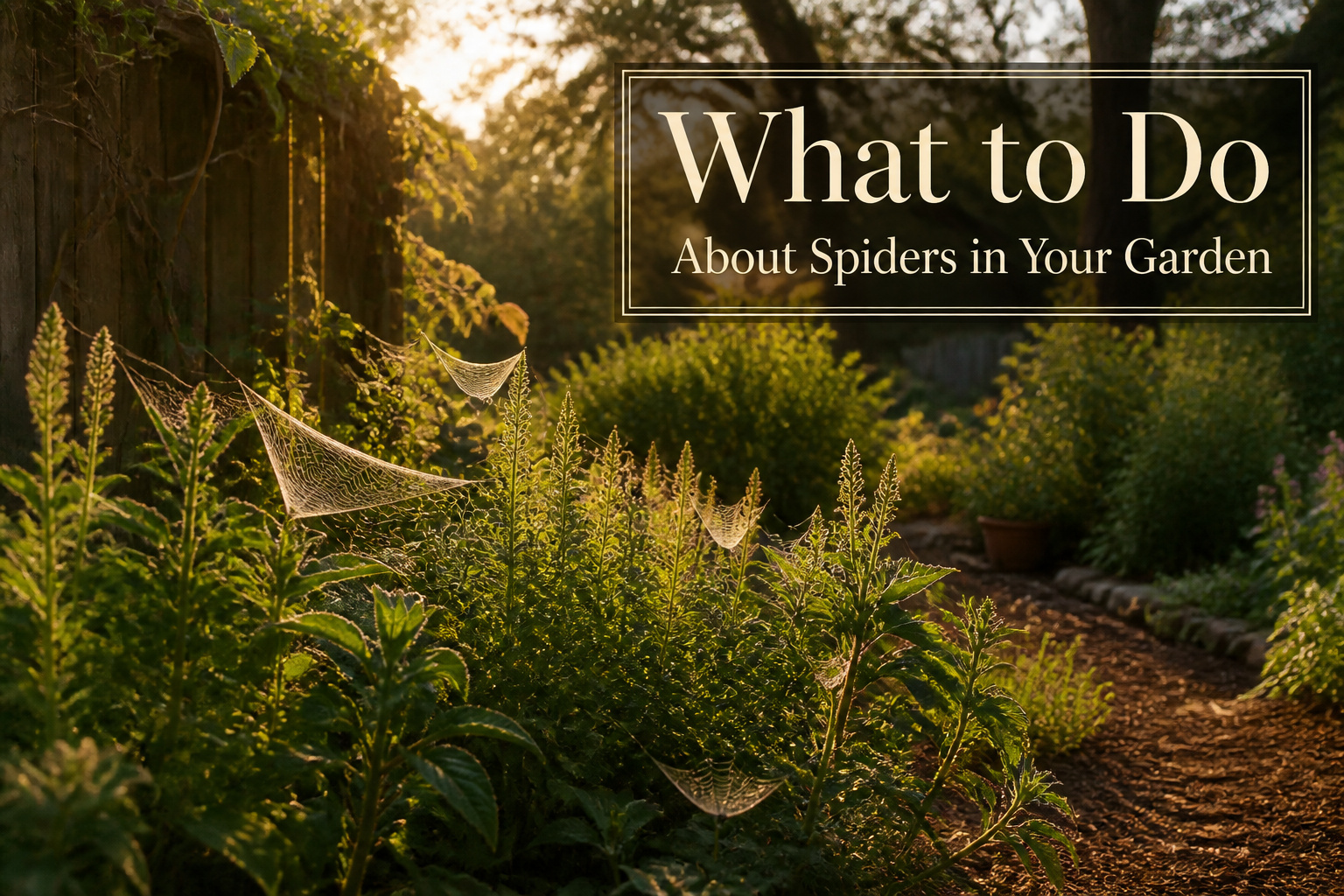
The answer to what to do about spiders in your garden depends on whether you want fewer spiders near your doors or fewer pests on your plants, because the same steps work differently depending on the goal. Clearing leaf litter and stacked pots dropped web clusters along my fence within a week, but leaving orb-weaver webs alone the next season solved an aphid problem I had spent forty dollars trying to kill.
Remove Hiding Spots

Leaf litter and loose twigs give spiders exactly the cover they want. In my small yard, the pile of dead leaves along the fence line turned out to be the biggest draw; once I raked it out and bagged it, the web clusters along that edge dropped off within a week. Unused flowerpots stacked against the house are another problem, especially since black widows and other cobweb spiders use them as shelter. I had six or seven terracotta pots I kept meaning to replant; storing them in the shed instead of the garden bed removed a hiding spot I had not even counted. Grass clippings left after mowing and loose yard debris matter too, though less dramatically in my space. The work took one Saturday morning with a rake and a few contractor bags, and the maintenance is just keeping the corners clear after that.
Trim Vegetation

Overgrown branches that touch the house are the first thing I cut back, because they let spiders drop straight onto siding or find gaps around windows. Anything within about a foot of the exterior wall is too close — that gap is what stops them from bridging across. Shrubs and bushes get the same treatment, especially where they’ve grown dense enough to stay dark and still at the base. I prune for air and light, not shape; an open plant is less useful as harbor. Fallen leaves and any produce on the ground go next, since those piles are exactly the quiet, undisturbed spots spiders prefer. The mowing and raking are follow-up, not the main event.
Clean Patios and Decks
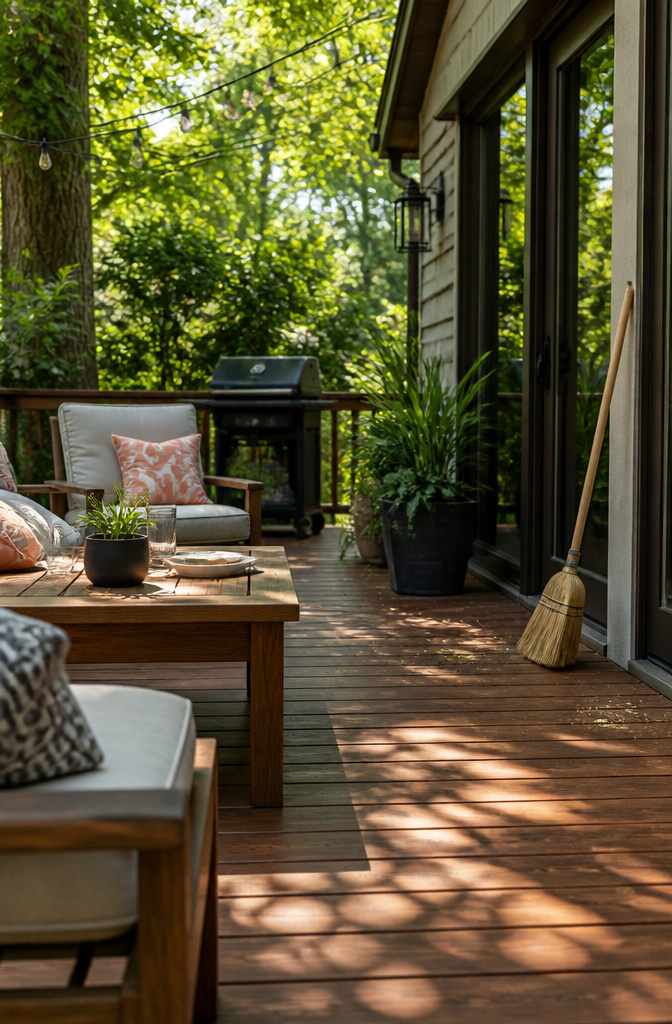
Crumbs and spills left after outdoor meals draw the insects that spiders hunt, so the patio or deck becomes part of the problem whether you notice it or not. I sweep mine after every evening outside, and every few weeks I pull the cushions off the chairs and wash them down. Knocking down webs as you find them matters just as much; a broom, a cobweb brush, or even a hard spray from the hose will take them off furniture, eaves, and the corners where porches meet the house. The cleaning is not dramatic work. It is repetitive, and that is the point. Spiders rebuild fast where food keeps showing up, so removing the webs without removing the crumbs just starts the cycle again. I do the full routine, cushions and all, about every two to three weeks through the warm months. Less often than that and the webbing starts to collect in the spots you do not look at directly, the underside of chair arms and the gap between the railing and the house wall.
Remove Spider Webs

A web can stretch twenty times the size of the spider that built it, which means the corner of your porch that looks empty by daylight is prime real estate by evening. I walk the yard with a long-handled cobweb brush every Saturday morning, before the dew dries and the silk turns sticky. The tool matters less than the rhythm: eaves first, then the gaps between deck boards, then the tomato cages where orb-weavers love to anchor. Knock the web down and the spider usually relocates rather than rebuild in the same spot. A broom works, and so does a sharp blast from the hose, but the brush lets me reach the high corners without dragging a ladder out. I skip the webs that have egg sacs tucked into them; those I cut free with scissors and move to the back fence line, far from the doors. Consistency beats thoroughness. A spider will tolerate one destroyed web, maybe two, but by the third Saturday of finding its silk on the ground, it tends to move on to a quieter yard.
Minimize Outdoor Lighting

The porch light above my back door used to draw a cloud of moths by ten o’clock, and by morning the railing beneath it would be strung with orb-weaver silk. Swapping that bulb for a yellow "bug light" bulb was the cheapest experiment I tried. The color temperature is harsh, almost sickly, and I still miss the clean white light when I take the garbage out after dark. But the moths stopped coming, and within two weeks the spiders relocated to the unlit side of the house where the garden hose sits.
Sodium vapor is the other option the hardware store stocks for this purpose, though the fixtures cost more and the orange glow makes your yard look like a parking garage. Either type works on the same principle: night-flying insects navigate by moonlight, and they mistake broad-spectrum bulbs for it. Yellow and sodium vapor bulbs emit wavelengths insects do not read as a beacon, so the food web never starts assembling on your siding.
Motion sensors help too, but only if you actually let them stay dark most of the night. I tried leaving the sensitivity high so every raccoon triggered a flash; the spiders just learned to web up around the fixture during the day and feed when the light startled insects into flight.
Plant Spider-Repelling Plants

Some plant fragrances can help repel spiders and other pests, and the ones that actually survived my zone 6 winters are the ones worth planting. Lavender and rosemary made it through three seasons near my patio steps; mint spread so aggressively I had to move it to a contained bed by the driveway. Thyme barely hung on in a raised planter, and citronella never came back after the first frost, so I stopped buying it.
I keep the lavender in two terracotta pots flanking the back door and the rosemary in a single large container on the deck rail, close enough that brushing past them releases the oil. The mint went into an old galvanized tub with drainage holes punched through; without that barrier it would have taken the garden bed in a single summer. Placement matters more than abundance: a few well-sited plants do the same work as a border full of half-hardy ones that need replacing yearly.
Use Natural Repellents

Vinegar and essential oils both work as surface-level deterrents, though neither kills spiders or fixes the conditions that draw them in. For my last spray, I mixed about two tablespoons of white vinegar into a full spray bottle of water and added five or six drops of peppermint oil. The smell was sharp enough that I believed spiders would notice it, and they did seem to avoid the treated areas for a few days.
I sprayed the mixture along the base of my patio planters, around the threshold where the concrete meets the house, and across the underside of a wooden bench where I kept finding silk residue. Reapplication every three to four days was necessary; after a rain or a hot afternoon, the scent faded and new webbing appeared in the same spots by the following week.
The cost sits comfortably under ten dollars for a bottle of vinegar and a small vial of oil that lasts multiple batches. For a renter with weekend limits, this is a low-stakes experiment. The downside is the upkeep. If you need something that holds without your attention, sprays will disappoint. I treat them now as a bridge fix while I work on the clutter and lighting that actually keep spiders stationed in one place.
Diatomaceous Earth

Diatomaceous earth works by cutting the waxy coating off soft-bodied insects and arachnids, which dries them out over a day or two. I picked up a bag labeled for garden use from the hardware store, not the pool-grade version, which is processed differently and not meant for this job.
Application is straightforward: the powder needs to stay dry to do its job, so I waited for a clear stretch and dusted it along the base of my raised beds, around the legs of a potting bench where webs collect, and in the gaps between patio stones where wolf spiders like to hole up. A cheap squeeze bottle with a pointed tip gave me control without flinging it everywhere or coating plants I wanted to keep.
The catch is reapplication. Rain or heavy dew washes the stuff away, and a strong breeze carries it off before anything walks through it. I treat it as a spot solution for problem corners rather than a blanket treatment, which keeps the cost low and leaves the garden’s actual pest control, the spiders that aren’t bothering anyone, mostly alone.
Why Spiders Belong in Your Garden

Three years ago, I would have cleared every web I found in my tomato beds without a second thought. Then aphids took over my kale in a single July weekend, and I spent forty dollars on insecticide that also killed the ladybugs I’d been trying to attract. That was the season I started leaving the webs alone.
Spiders eat aphids, caterpillars, beetles, mosquitoes, and flies. Orb-weavers catch flying pests in their webs between plants, while wolf spiders and jumping spiders hunt on the ground in mulch and leaf litter. A garden thick with spiders is usually a garden thin on chemical sprays, because the spiders are doing the pest control for free. Broad-spectrum insecticides kill them along with everything else, which is why cutting back on sprays does more to manage spider populations than any targeted removal. I stopped spraying, added a layer of mulch, and by the next spring the aphid problem had faded without my intervention.
The webs still startle me on dewy mornings, especially the big orb-weavers that show up in fall. But I have never been stuck in one, and I have never been bitten. The spiders stay busy catching insects, and I stay busy not ruining the balance by reaching for a broom.
Common Garden Spiders

Orb-weavers are the spiders most people picture when they think of a garden web. These are the ones building those large, circular webs between plants, usually in late summer and fall when they become especially visible with morning dew catching the light. In my garden, they are the ones I spot first, and they are doing exactly what the garden needs: trapping flying insects like flies, moths, and mosquitoes before those pests reach the plants.
Wolf spiders patrol the ground instead, hunting through leaf litter and mulch without any web at all. They are fast, stealthy, and focused on insects hiding in debris that gardeners might never notice. Jumping spiders work the same territory but with a different style, pouncing on prey rather than chasing it down. They are small, compact, and often mistaken for black widows because of that body shape, though their bite is not venomous to humans and only causes minor itching if it happens at all.
The spiders doing the most work are usually the ones gardeners want gone. Orb-weavers in particular get cleared away because their webs are obvious, but those webs are actively catching pests during the final months of the growing season. Wolf spiders and jumping spiders are harder to spot, which means they tend to survive human interference and keep hunting.
When Spiders Are Actually Dangerous

Most spiders in a garden are harmless helpers, but two species deserve real caution. The black widow carries a nerve toxin that acts fast. A bite brings painful abdominal rigidity, chest tightness, rising blood pressure, and sweating, with rare cases leading to convulsions 12 to 24 hours later. First aid means cleaning the wound, icing it to slow venom absorption, and getting to a doctor promptly. Pain medication and muscle relaxants usually handle it, though antivenin exists for severe cases. Only the females pose danger to humans, and bites happen mainly when a hand reaches under a pot or into a dark corner where the spider is hiding.
The brown recluse is trickier to spot. It ranges from dark cream to dark brown, darker on the abdomen, with a violin-shaped marking on the top of its front section. Six eyes instead of the usual eight help confirm it. These spiders favor wood piles and shaded garden spots. Their venom is not typically deadly, but a bite can mean serious tissue damage, especially if you’re among the allergic. Neither spider is aggressive. Both bite when threatened or pressed against skin, so gloves and a quick visual check before grabbing are the habits that matter.
Frequently Asked Questions
How do I get rid of spiders outside?
The most effective approach is to reduce the insects they hunt and knock down their webs regularly. Swapping standard outdoor bulbs for yellow bug lights cuts the moth and fly traffic that draws spiders to your siding. Removing leaf litter, stacked pots, and other hiding spots takes away shelter, while consistent web removal with a broom or hose convinces spiders to relocate.
What plants repel spiders?
Lavender, mint, rosemary, thyme, and citronella are the ones most commonly mentioned, though hardiness varies by climate. In a zone 6 garden, lavender and rosemary survived multiple winters, while citronella died back after the first frost and mint spread aggressively enough to need a contained bed. Placement matters more than quantity; a few well-sited plants near patios and doorways release enough fragrance when brushed to make spiders look elsewhere.
Are all spiders harmful?
Most garden spiders are harmless and actually helpful, eating aphids, caterpillars, mosquitoes, and flies. Only two species in most U.S. regions pose real danger: the black widow, whose bite causes severe muscle pain and requires prompt medical care, and the brown recluse, which can cause significant tissue damage in sensitive individuals. Neither is aggressive; bites happen mainly when a hand reaches into a dark hiding spot without checking first.