
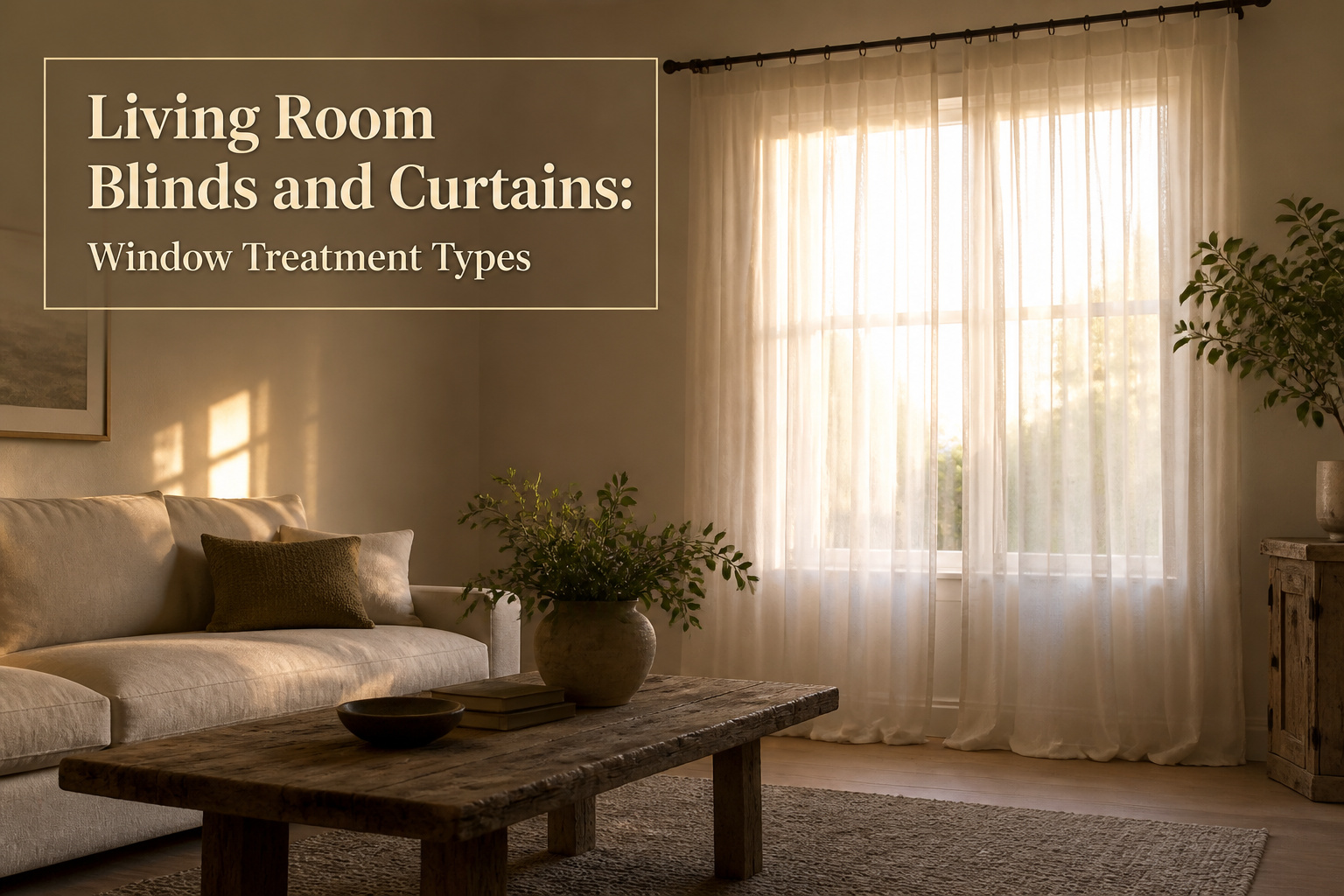
Living room blinds and curtains are the two main categories of window treatment, and most rooms end up needing both. The catch is that blinds solve light control while curtains solve atmosphere, and buying only one usually leaves half the problem untouched. With eight distinct types now common for 2026 installs, from honeycomb cells that cut heating bills to vertical systems that finally escaped their office-building reputation, the choice depends on whether your window faces a street, a sunset, or a sliding door you open twice daily.
1. Drapery

Drapes bring a softness that blinds and shades never quite match, and in a living room where you actually sit and unwind, that matters. The fabric absorbs sound, frames the window like finished carpentry, and closes the room off completely when you need privacy after dark. Heavy linen or velvet in a neutral tone reads as intentional without shouting for attention; a subtle pattern or texture keeps it from looking like a rental default.
The hanging style changes everything. Rod pocket drapes sit flat and casual, while back-tab or ring-top panels stack in cleaner folds that read more tailored. For living room blinds and curtains layered together, mount the drapes wide and high so they clear the shade hardware and never fight it. Many homeowners pair window shades with living room curtains specifically for this balanced look: the shade handles daily light and neighbor-blocking, the drapes add the softness and the final blackout at night.
Drapes win over harder treatments when your living room windows are oversized or when you are covering sliding doors that need to disappear completely. They are the wrong call in a tight space where fabric crowds the furniture, or in a kitchen where grease settles into the folds. For the living room, though, they are usually the right finishing layer.
2. Woven Wood Shades

Woven wood shades bring a simple, contemporary look that works especially well in living rooms where you want texture without clutter. The weave itself is the decoration; no pattern or print competes with whatever else is in the room. These shades are made from all-natural materials like bamboo, grasses, and reeds, sourced from a range of global suppliers, and the material shows through even when the shade is lowered.
Light filters through the small gaps in the weave, so the room stays bright but glare softens. That makes them a solid choice for south- or west-facing living room windows where direct sun would otherwise bleach the sofa or floor. The filtering is not blackout-level; you will still see the shape of the window and the time of day. If you need darkness for a screen, pair them with curtains on a double rod and pull the drapes shut for movie hours. The layered look also helps in rentals where the window frame itself is nothing special; the shade covers the glass, the curtains frame the whole unit, and neither has to look expensive to read as intentional.
Sustainability is part of the appeal for some buyers, though the real practical win is the warmth the material adds to a space that can otherwise feel flat. I would not put woven wood in a kitchen or bath where grease and moisture stain the fibers, but in a dry living room they hold up well for the price.
3. Solar Shades

Solar shades filter the sun without killing the view, which makes them a natural fit for living rooms that face a yard, a skyline, or any window you actually want to look through. The fabric is the whole story here: the market now runs past 150 exclusive materials, from warm neutrals that read like linen to tighter weaves that look almost metallic. Each carries an openness factor, measured in percentage, that tells you exactly how much light gets through. A 14% openness keeps the room bright and the glare soft; drop toward 0% and the fabric turns nearly opaque while still rolling up out of sight.
That range matters for protection. UV fades hardwood, dries leather, and bleaches artwork even on overcast days. Solar shades block the damage while leaving the window functional. The tradeoff is night privacy: after dark the effect reverses, and anyone outside can see in more easily than with a true blackout. For a living room that gets used mainly in daylight hours, that is often an acceptable swap.
4. Roman Shades

Roman shades sit in that useful middle ground between a casual roller and full formal drapery. The fabric stacks into soft, even folds as you raise it, so the window keeps its tailored silhouette whether the shade is up or down. That structured stack adds depth a flat shade cannot, and in a living room with a lot of white or neutral walls, the folded fabric becomes one of the few sources of visual texture in the room.
You will find six distinct styles of fold to choose from, running from the crisp, knife-pleated look to a more relaxed, drooping soft fold. Each one reads differently: the tighter folds feel more finished and intentional, while the looser ones lean casual enough for a rental you are dressing up without over-investing. The shade sits inside the frame for a clean line, or outside it to make the window feel larger, and the fabric options run past 500 materials if you are ordering custom.
A lining choice matters more here than with drapery. Free privacy or blackout lining is typically included, and the layered construction, a light-filtering face with a room-darkening back panel, gives you the control you need for a living room that doubles as a TV space. The finished look, no exposed rear cords on some lines, also reads cleaner from the street. For a few hundred dollars and a weekend of measuring, Roman shades make the window feel built into the design rather than an afterthought.
5. Cellular Shades

The honeycomb structure in cellular shades is what makes them worth considering for a living room that gets afternoon sun or faces a cold northern exposure. Each cell traps a pocket of still air between the fabric layers, and that air becomes the insulation. The Shade Store lists 50+ exclusive materials for this exact construction, which means the difference between a thin single layer and a heavier one is a choice you make at order, not a compromise you accept.
Duette’s Architella line takes this a step further with a honeycomb-within-a-honeycomb design, two sets of cells nested together. The company claims this extra depth cuts energy consumption noticeably, though in practice the gain matters most on older single-pane windows. With double-glazed glass already in place, the standard cellular construction still delivers roughly 75% UV filtration, which is enough to keep a south-facing sofa from fading without turning the room into a cave.
The catch is that cellular shades read as modern and utilitarian. They do not drape or fold like fabric; they stack flat and disappear, or they don’t. For a living room where you want warmth and texture visible even when the shade is drawn, this is the wrong choice. For a room where the windows are large, the heating bills are real, and the walls already carry the visual weight, the efficiency tradeoff is sensible.
6. Metal Blinds

Aluminum slats still handle light better than almost anything else in the budget tier. A 2-inch slat tilts from full blackout to filtered daylight without lifting the whole shade, which matters when the living room faces west and the afternoon sun hits the sofa directly. Nine finishes run from bright white to matte bronze, enough to match trim or disappear against it.
The durability is real. These blinds survive a rental turnover, a cat who bats at slats, and years of tilt-cord use without sagging the way vinyl can. Weight keeps them flat and quiet in a window frame.
Where they lose ground is the look. The same metallic finish that reads clean in a kitchen turns cold against soft living room textiles, and the stack at the top never gets compact enough to feel architectural. For renters who need blackout on a Saturday install and a hundred-dollar ceiling, that trade is usually worth it. Owners staying longer tend to layer a curtain panel over the blind and hide the hardware entirely.
7. Vertical Blinds

Vertical blinds handle the oversized openings that stop most other treatments cold. A wall of glass or a sliding patio door in a living room needs something that stacks completely out of the way, and the vertical format does that without the bulk of drawn drapes. The clean lines read modern in a way that the older generation of these blinds never managed, and the 250-plus exclusive materials now available mean you are not stuck with the beige vinyl that used to define the category.
The revival is real. Contemporary spaces are using vertical blinds again because the fabric options, textures, and patterns have caught up to what people actually want to live with. Sheer vertical panels with soft fabric vanes behind them give you the drama of traditional drapery but keep the minimal profile that works in a modern living room. For something even sleeker, gliding window panels in fashion-forward colors and textures make the same statement without any lingering office-building association.
On a sliding glass door, the operation is the practical win. The vanes tilt for light control or draw fully to one side so the door stays usable. That matters more than most people realize until they try to wrestle a heavy curtain across a doorway twice a day.
8. Motorized Drapery

Motorized drapery solves the problem of windows that sit behind a sofa, up a stairwell, or anywhere a hand-drawn panel turns into a daily stretch. Battery-powered tracks run on rechargeable cells that tuck behind the valance, while wired systems tie into the home’s electrical and never need a ladder for upkeep. Battery models suit renters who cannot open walls, since the install clips to the ceiling like a standard rod and moves out with you. Wired tracks cost more upfront and need an electrician, but they integrate with Alexa or Google Home for scheduled opens at sunrise and closes after dark. The upgrade stings until you price the labor: a standard drapery install already runs about 10% of the treatment cost, and the motor premium narrows if you factor in the years of not climbing furniture. For a single reachable window, the convenience is hard to justify. For three story-height panels or a wall you treat like a light switch, the motor pays for itself in saved hassle.
Blinds or Curtains

Blinds and curtains each solve a different problem in a living room, and the choice usually comes down to which problem you hit first. Blinds give you precise light control; tilt the slats and you cut glare on a screen without killing the daylight. Curtains add softness, texture, and height, and they frame the window even when they are open. Privacy works differently too: blinds close to a solid surface, while curtains rely on fabric weight and lining.
Most homeowners end up layering both. A blind handles the daily light adjustments, and curtains soften the edges and cover the stack when you want the window to look finished. Light-filtering fabrics keep a room bright during the day while still cutting glare, which matters if your living room doubles as a TV room.
| What you need most | Blinds | Curtains | Both |
|---|---|---|---|
| Light control | Precise tilt adjustment | Depends on fabric weight; sheer options filter, heavy options block | Best of both: blind for adjustment, curtain for mood |
| Privacy | Closes to solid surface | Needs lining or layering to fully block view | Blind closes at night, curtain adds coverage |
| Aesthetic | Streamlined, architectural | Softens walls, adds height and texture | Layered look that balances function with design |
| Flexibility | Easy to adjust hourly | Best left open or drawn for longer periods | Curtain stays in position, blind does the daily work |
If your budget only covers one step right now, start with the blind. It handles the functional need immediately. Add curtains later when you want the room to feel dressed rather than just solved.
Sizing Your Living Room

Visual weight is the first thing to get wrong in a small living room, and I have. A heavy cornice or a dark, pooling drape that looked elegant in the store can shrink a 12-foot wall into something cave-like once it is up. The treatments that actually keep the room breathing are streamlined shades, simple blinds, or light-colored curtains hung close to the ceiling. Each of these sits flat or reads as air rather than mass.
Streamlined shades and simple blinds do the same job from different angles. Both keep the window plane smooth so the eye travels past it instead of stopping to process bulk. Light-colored curtains add the same trick vertically: pale fabric hung high draws the gaze upward and lets the ceiling feel taller than the tape measure says it is. I learned the hard way that "neutral" in a dim store reads darker at home; the samples that worked were the ones I almost dismissed as too plain.
Larger rooms flip the problem. A single roller shade on an 8-foot window looks like a postage stamp, and that is where layered treatments earn their keep. Living room curtains paired with shades or blinds add the warmth and dimension a big wall demands, plus you get two stages of light control for morning coffee versus afternoon glare. The mistake is layering in a space that cannot afford it; start with the room’s square footage, then decide whether you are adding or subtracting visual weight.
Layering Treatments

Layered living room blinds and curtains give you two ways to adapt to changing light through the day without swapping hardware seasonally. In my own reading, the pairing that keeps coming up is a streamlined shade or blind for blocking or filtering light, hung inside the window frame, with curtains mounted on a rod several inches above and outside it for softness and full coverage at night.
The practical sequence matters more than most people expect. Mount the blind first, because its brackets sit inside the frame and its headrail defines the clean edge. The curtain rod goes up after, high and wide enough to stack clear of the blind when both are open. Reverse that order and the rod placement starts guessing where the blind will land.
Smaller living rooms stay calmer with neutral, light-colored curtains that let the eye travel upward; larger rooms can handle heavier layering without the walls closing in. The real payoff is control: lower the cellular shade against afternoon glare, draw the curtains after dark for the sense of a finished room. One handles the job, the other handles the mood.
The living room is where we live our lives… whatever your particular need, you’ll find many living room blinds and shades that are as fashionable as they are functional.
That line stuck with me because it cuts past the style question to the actual test: does this pairing match what you do in that room at 3 p.m. versus 8 p.m.? If you read there, you need the shade. If you host there, you need the curtain. Most of us do both, which is why the layer wins.
Material and Customization

The range of fabrics and weaves matters more than the brand name on the tag. One retailer carries over 1,200 materials, another lists 650-plus exclusives, and the gap between those numbers tells you something about how deep these catalogs run. What you actually need is a free swatch held up to your own window at noon, not a screen rendering under warm LED bulbs. Linen that reads creamy online can shift gray in northern exposure, and woven wood textures that look beachy in a showroom turn muddy against terracotta tile.
Matching the material to what you already own is a judgment call, not a science. I tend to run the sample against the largest fixed surface in the room, usually the sofa or the rug, and look for either a quiet echo or a deliberate contrast that still shares the same undertone. Cornices and hardware finishes are where this either comes together or falls apart; a brass rod against matte black window frames reads like an afterthought unless you meant it. Blackout lining and privacy backing are worth ordering with the original cut, since retrofitting later means taking the whole treatment down and paying twice for labor you already spent a Saturday on.
Frequently Asked Questions
What are the best blinds for a living room?
The best living room blinds give you flexible light control while matching the room’s style. Adjustable slats let you cut glare without losing daylight, and pairing blinds with curtains adds warmth through layering. For south- or west-facing windows, solar shades or woven wood filters protect furniture from UV damage while keeping the view.
What are the best window treatments for a small living room?
Streamlined shades, simple blinds, or light-colored curtains hung high and close to the ceiling keep the space open. Heavy or dark treatments shrink a small room visually, so pale fabrics that draw the eye upward work better. Avoid bulky layering unless the square footage can support it.
Should you choose blinds or curtains for living room windows?
Most living rooms end up needing both. Blinds handle precise daily light adjustments and close to a solid surface for privacy. Curtains add softness, texture, and height, framing the window even when open. If your budget covers only one now, start with the blind for function and add curtains later for the finished feel.
How do you style curtains in a living room?
Start with the right fabric, length, and color for your specific light and furniture. Floor-length panels read more tailored and draw the eye upward. Mount the rod wide and high so panels clear any blind hardware and stack cleanly to the side.
What type of curtains are best for a living room?
The best type depends on how you use the room. Light-filtering fabrics brighten the space while softening glare for daytime reading and TV. For privacy after dark or full blackout for movie hours, add a lining or layer with a shade. Hold fabric samples against your largest fixed surface, usually the sofa or rug, before ordering.